
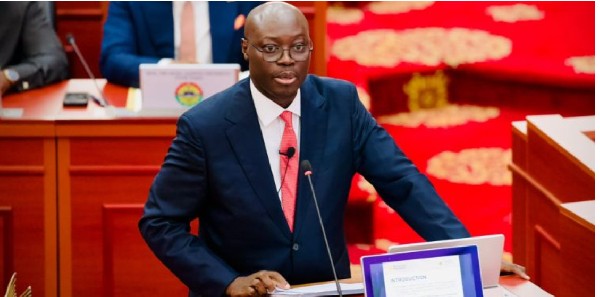
Finance Minister Dr Cassiel Ato Forson told Parliament on Thursday, November 12, 2026, that Ghana's dependence on raw commodity exports has driven the repeated economic crises that have hit the country despite more than three decades of growth.
Presenting the 2027 Budget Statement and Economic Policy, the Minister said the country's reliance on gold, cocoa and oil has left the economy exposed to global price swings, making it difficult to sustain growth and raise living standards for ordinary Ghanaians. GBC Ghana reported that the government plans to invest $10 billion in a new economy programme from 2027 to 2030, a signal that the response will be structural rather than cosmetic.
Growth without resilience: the numbers behind the diagnosis
Dr Forson did not hide behind the headline figures. GDP growth averaged 5.2 percent over the period under review, yet he argued that the number conceals the volatility within it.
“GDP growth averaged 5.2 per cent. That record tells us that Ghana is capable of economic expansion, but it also conceals the volatility within that growth,” he said, according to GhanaWeb.
The Minister explained that periods of high commodity prices have boosted government revenue and confidence, but falling prices and weak fiscal management have repeatedly pushed the economy into difficulty, bringing high inflation, rising interest rates and reduced investment. Adomonline reported his central point in plain terms: Ghana has grown but failed to build enough economic resilience.
Extractive industries accounted for about 16 percent of GDP growth over the last decade, while unemployment stood at approximately 12.8 percent in January 2026. For Dr Forson, those two figures side by side expose the structural flaw: Ghana can record growth without creating enough jobs and opportunities for its people.
“The result is an economy that can post growth figures whilst leaving too many citizens outside the promise of that growth,” he stated.
The 2022 crisis: what commodity dependence costs
The Finance Minister pointed to the 2022 economic crisis as proof of the danger of using temporary commodity gains to fund permanent government spending. He said excessive expenditure, weak revenue mobilisation and costly borrowing pushed the country into debt distress.
The figures he cited were stark. By the end of 2022, inflation had reached 54.1 percent, the primary balance had recorded a deficit of 4.3 percent of GDP, and international reserves had fallen below three weeks of import cover. Ghana's debt had also exceeded 100 percent of GDP under the IMF's debt sustainability assessment.
Dr Forson insisted the crisis went beyond statistics. Households struggled with rising food prices, transport fares, medicine costs and high borrowing rates, while businesses collapsed and families delayed important expenses.
“The crisis affected every household and business. It imposed severe hardships on families. It made food too expensive to buy. It raised transport fares and the cost of medicine,” he said.
The debt restructuring programme compounded the pain, hitting pension funds, banks, businesses, investors and households through losses on their investments and savings.
A historical pattern, not an accident
The Minister framed the problem as a long-running national pattern rather than a recent failure. MyJoyOnline reported his argument that Ghana has struggled to sustain a shared economic direction since the era of Dr Kwame Nkrumah, with gold, cocoa and later oil dominating exports and deepening the country's vulnerability to external shocks.
For a country that has ambitions to become the commercial hub of West Africa, that diagnosis carries a clear message. Exporting raw gold, raw cocoa and crude oil means exporting jobs along with them. Every tonne of unprocessed cocoa leaving Takoradi is value added somewhere else, in factories that employ other people's workers.
The answer, on the Minister's own logic, is value addition: processing what Ghana produces at home, building industrial capacity, and widening the tax base so the state does not lurch from boom to bust with every price cycle. It is also about fiscal discipline, because commodity windfalls spent rather than saved are the root of the debt distress he described.
Dr Forson closed on a note that will resonate far beyond Parliament, including with the Ghanaian diaspora whose remittances keep thousands of households afloat.
“The Ghanaian people paid a heavy price. We owe them something greater than recovery. We owe them a country that honours their sacrifices and ensures that the hardships they have endured do not become the inheritance of their children,” he said.
The 2027 Budget now before Parliament will show whether that promise translates into concrete spending on industry, skills and job creation, or whether the commodity cycle wins once again.
FAQ
What did Ato Forson say caused Ghana's economic instability?
Presenting the 2027 Budget on November 12, 2026, the Finance Minister blamed Ghana's dependence on raw commodity exports, mainly gold, cocoa and oil, which exposes the economy to global price swings.
What was Ghana's average GDP growth rate according to the 2027 Budget presentation?
Dr Forson said GDP growth averaged 5.2 percent over the period under review, but warned the figure concealed volatility and excluded too many Ghanaians from the benefits of growth.
How bad was Ghana's 2022 economic crisis?
By the end of 2022, inflation reached 54.1 percent, the primary deficit hit 4.3 percent of GDP, reserves fell below three weeks of import cover, and debt exceeded 100 percent of GDP under the IMF's assessment.
What is government planning in response?
GBC Ghana reported that the government intends to invest $10 billion in a new economy programme running from 2027 to 2030.