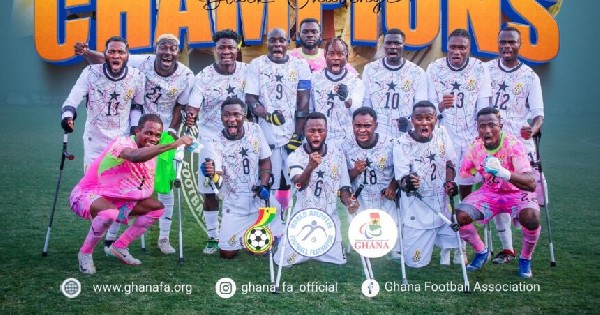
Ghana’s Black Challenge won the country’s first Amputee Football World Cup on Sunday, November 22, 2026, beating Morocco 1-0 in San Juan de los Lagos, Mexico, and prompting calls for rewards equal to those given to other national teams.
The victory has moved the conversation beyond celebration. Supporters now want President John Dramani Mahama, Sports and Recreation Minister Kofi Adams and Ghana’s business community to turn a historic sporting achievement into lasting support for the players and disability sports.
How Ghana won the Amputee Football World Cup
Ghana’s national amputee football team secured the 2026 WAFF Amputee Football World Cup title with its narrow victory over Morocco, Ourhomeland reported. The result completed a campaign that included wins over the United States, Turkey and Egypt.
Forward Mubarik Mohammed finished as the tournament’s top scorer with seven goals and received the Golden Boot. The Sports Writers Association of Ghana praised the players, technical team and management as worthy ambassadors who had brought honour and pride to the nation, according to Ghana Business News.
The Ministry of Sports and Recreation joined the tributes on Monday, November 23. It praised the players, technical team and officials, describing the triumph as a moment of immense national pride.
“You wore the Black Star on your chests and gave Ghanaians at home and abroad the joy of saying, with one voice, ‘We are world champions!’” the ministry said.
That message will resonate far beyond Mexico. For Ghanaians in the diaspora, the Black Challenge have supplied a powerful story of excellence, discipline and national possibility. For young athletes living with disabilities, the team has offered visible proof that talent deserves a bigger stage and stronger backing.
Why Black Challenge players deserve cars
A GhanaWeb commentary argues that every member of the Black Challenge should receive a car, citing the precedent set after the Black Stars reached the 2015 Africa Cup of Nations final in Equatorial Guinea.
The Black Stars finished runners-up and received Jeep Grand Cherokee vehicles during Mahama’s first presidency. GhanaWeb said the same generosity should apply to a national team that has now gone further by winning a world title.
The comparison is not an attack on the Black Stars. It is a test of consistency. If reaching a continental final justified a substantial national reward in 2015, winning a world championship in 2026 presents an even stronger case.
The Black Challenge’s record also reaches well beyond one successful tournament. Ghana won the African Amputee Football Cup in 2021 by defeating Liberia, then retained continental supremacy in 2024 with victory over Morocco. The team added gold at the 2023 African Para Games in Accra.
Those results show sustained performance across five years. They also contrast with the Black Stars’ wait for a senior Africa Cup of Nations trophy, which has continued since 1982.
A reward can become an investment
Cars would recognise individual sacrifice, but the wider opportunity is to build a durable system around the champions. A clear national rewards policy would reduce uncertainty and show athletes across all sporting disciplines what excellence earns.
That policy should cover preparation, medical care, equipment, travel and life after competition. It should also apply transparently to Olympic, Paralympic, amputee and other national teams, with published criteria that do not depend on which sport commands the largest television audience.
Ghana’s private sector has a role as well. Companies searching for credible partnerships can support a team with a world title, two recent African championships and a compelling record of consistency. Sponsorship can fund training and competition while giving brands an authentic connection to Ghanaian achievement.
Diaspora networks can strengthen that effort through equipment drives, professional expertise and international partnerships. The aim should be a programme that survives the celebrations and prepares the next squad, rather than a burst of donations followed by another struggle for resources.
There is an economic argument here. Sporting success creates value when athletes can train properly, coaches can develop careers and local competitions can attract audiences and partners. The Black Challenge have already delivered the hardest part: results against leading international opponents.
What happens next for the champions?
The immediate decision rests with government and potential backers. GhanaWeb directed its appeal to Adams and Mahama, asking them to consider a car for every member of the team. It argued that a lasting reward would encourage investment in disability sports and motivate future generations.
The champions should not return to a routine of inadequate support after giving Ghana a world title. Their achievement offers the government a practical chance to state, through policy and action, that disability does not diminish excellence.
Ghana now has African titles from 2021 and 2024, African Para Games gold from 2023 and a world crown from 2026. The next measure of national ambition is whether the structures around the Black Challenge become as strong as the team itself.
Frequently asked questions
Who did Ghana beat in the 2026 Amputee World Cup final?
Ghana beat Morocco 1-0 in San Juan de los Lagos, Mexico, on November 22, 2026, to win the country’s first Amputee Football World Cup.
Why are supporters asking for cars for the Black Challenge?
They cite the Jeep Grand Cherokee vehicles given to the Black Stars after the team reached the 2015 Africa Cup of Nations final and argue that Ghana’s world champions deserve comparable recognition.
Who was the tournament’s top scorer?
Ghana forward Mubarik Mohammed won the Golden Boot after scoring seven goals during the tournament.