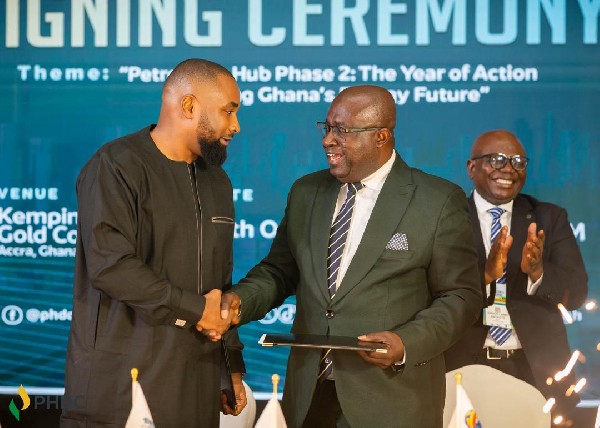
Ghana has taken a decisive step toward becoming West Africa's petroleum processing powerhouse. On Monday, October 19, 2026, the Petroleum Hub Development Corporation signed a US$28 billion Build-Operate partnership with an international consortium led by Global Sphere to develop Lot 2 of the country's Petroleum Hub project in Jomoro.
Dr Toni Aubynn, Chief Executive Officer of PHDC, and Boubacar Belco Bah, representing investors from the United Arab Emirates, Mali and South Korea, executed the Memorandum of Understanding at a ceremony in Accra, according to GhanaWeb. Implementation begins immediately, with on-site work scheduled to start in the first quarter of 2027.
What the US$28 Billion Agreement Will Deliver
The scale is bold, and that is exactly what Ghana's energy sector needs. Within five years, the consortium is expected to build a world-class refinery with a capacity of 300,000 barrels per stream day, two petrochemical plants, four million cubic metres of storage infrastructure, and a multi-berth jetty.
That is not just infrastructure. It is a statement that Ghana intends to process its own resources, create industrial jobs at home, and capture far more value from every barrel it produces.
A Central Piece of the President's Energy Vision
Energy and Green Transition Minister Dr John Abdulai Jinapor described the Petroleum Hub project as central to President John Dramani Mahama's vision for transforming Ghana's energy sector. He pointed to Ghana's recent progress in the upstream oil and gas industry, which has heightened the need for infrastructure linking production to processing.
He reaffirmed the government's commitment to supporting PHDC and the investors through the development of Lot 2, and his message left no room for ambiguity about the direction of travel.
Government has been working tirelessly to develop this sector. The President's vision is clear: we cannot increase oil production without adding value to our resources. That is why the Petroleum Hub constitutes a pivotal element of the entire petroleum value chain.
The minister also framed the signing as a starting point rather than a finish line.
We have collaborated closely with Dr Toni Aubynn and his team to realise this ambition. I am delighted that today we are securing investors and partners through this US$28 billion agreement. Today's signing ceremony is not the culmination of the process; it is the beginning.
Investors Pledge Transparency and Ghanaian Participation
Speaking for the consortium, Boubacar Belco Bah expressed confidence in the partnership and pledged delivery within the agreed timelines. His remarks carried a tone that should reassure Ghanaians who have watched too many megaprojects stall: rigorous preparation, responsible risk allocation, transparent governance, and effective stakeholder coordination.
Ultimately, our success will be measured not by the agreement we sign today, but by the commitments we honour and the results we achieve together.
He said the consortium will work closely with PHDC, AMS Technologies, the Project Development Consortium, and qualified technical and financial institutions to deliver a project that is technically credible, commercially sustainable, and financially bankable.
We also intend to combine international expertise with meaningful participation by Ghanaian contractors, professionals, and service providers.
That commitment matters. If Ghanaian firms and professionals are embedded in the build from day one, the skills, contracts and capital stay here, and the diaspora engineers and financiers watching from Dubai, London or Seoul get a credible reason to come home and build with these partners. It fits a wider pattern of Ghana pushing for cleaner, more accountable institutions, as seen in recent calls for