
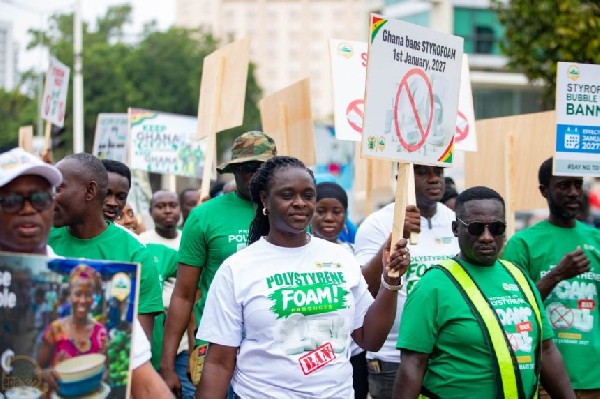
Ghana's Environmental Protection Authority (EPA) is taking its nationwide awareness campaign on the impending Styrofoam ban to the five northern regions this week, as the January 1, 2027, implementation deadline draws closer.
The week-long campaign, running from Monday, October 26, to Sunday, November 1, 2026, will cover the Northern, Upper East, Upper West, Savannah and North East regions. It targets consumers, manufacturers, distributors and other stakeholders who must prepare for the transition away from polystyrene foam products, according to GhanaWeb.
Tamale hosts the main northern belt event
The EPA has organised the exercise across three geographical zones: the southern belt centred on Accra, the middle belt centred on Kumasi, and the northern belt centred on Tamale. The Accra and Kumasi campaigns were held in July and August respectively, while the northern belt campaign is scheduled for Thursday, October 29, 2026, in Tamale.
A delegation led by the EPA's Chief Executive Officer, Professor Nana Ama Browne Klutse, will hold mini-durbars in Bolgatanga, Nalerigu, Damongo, Wa and other communities throughout the week, culminating in the main Tamale event, MyJoyOnline reported.
In a press release, Professor Klutse reaffirmed the Authority's commitment to ensuring the effective implementation of the ban in line with the directive of President John Dramani Mahama.
“The EPA is taking its time to create public awareness of the ban to prepare consumers, manufacturers and distributors for what is coming, effective January 1, 2027, so they can prepare and make the right lifestyle adjustments.”
“No one should have the excuse that they were not aware of this ban. There will be no excuses by January 2027. The EPA is fully ready to carry out His Excellency's orders to root this out from our country,” she added.
Why Ghana is banning polystyrene foam
The EPA announced the ban to address the environmental and adverse health impacts associated with polystyrene foam products while promoting more sustainable alternatives. The nationwide awareness campaign is intended to ensure that the public and industry players are adequately informed and prepared for the change.
For a country pushing aggressive economic reforms and positioning itself as a destination for green investment, the ban opens a real market opportunity. Local producers of biodegradable packaging stand to gain from a nationwide shift in demand, and the EPA has structured the campaign to give businesses sufficient notice to seize it.
Students take centre stage in Tamale
The Tamale event will feature an inter-school environmental quiz involving five second-cycle institutions: Ghana Senior High School, St. Charles Minor Seminary, Tamale Islamic Science Senior High School, Kalpohin Senior High School and Tamale Senior High School.
The competition will assess students' knowledge of environmental issues, the health risks associated with polystyrene foam products, the benefits of the ban and the lifestyle changes required before and after its implementation. The initiative is expected to strengthen environmental awareness among young people and encourage them to become advocates for responsible consumption.
UDS and Bagabaga College debate the economics of the ban
The event will also feature a debate between the University for Development Studies (UDS) and Bagabaga College of Education on the motion: “Beyond the ban: Can Ghana turn the polystyrene foam products phase-out into public health, environmental and economic benefits?”
The UDS team comprises Angela Ansah as principal speaker, Adu Michel Chibaley as supporting speaker, and Shakiratu Cheltima Fuseini as summarising speaker. Bagabaga College of Education will be represented by Joseph Maadi Sagulo, Mbowura Clement Samira and Fuseini Abdul-Hakeem Tunteiya in the same speaking order.
Both institutions are also expected to showcase innovative alternative products they have developed to help address potential supply gaps once the ban takes effect. That detail matters. It signals that Ghanaian institutions of higher learning are already building homegrown substitutes rather than waiting on imports.
What happens before January 1, 2027
Ahead of the main event, public awareness floats will be held in the five regional capitals to mobilise residents. The Tamale gathering, expected to attract traditional authorities, school heads, students and other stakeholders, will be broadcast live across major television channels to extend its reach.
The EPA will also intensify media engagements and stakeholder consultations throughout the week, Adomonline reported. Its regional, area and district offices have been directed to step up public education as the implementation date approaches, with other EPA officials leading campaign teams on the ground.
Frequently asked questions
When does Ghana's Styrofoam ban take effect?
The ban on polystyrene foam products takes effect on January 1, 2027, according to the EPA.
Which regions does the October 2026 campaign cover?
The campaign covers the Northern, Upper East, Upper West, Savannah and North East regions, with the main event scheduled for October 29, 2026, in Tamale.
Who is leading the EPA campaign?
EPA Chief Executive Officer Professor Nana Ama Browne Klutse is leading the delegation, acting on a directive from President John Dramani Mahama.