
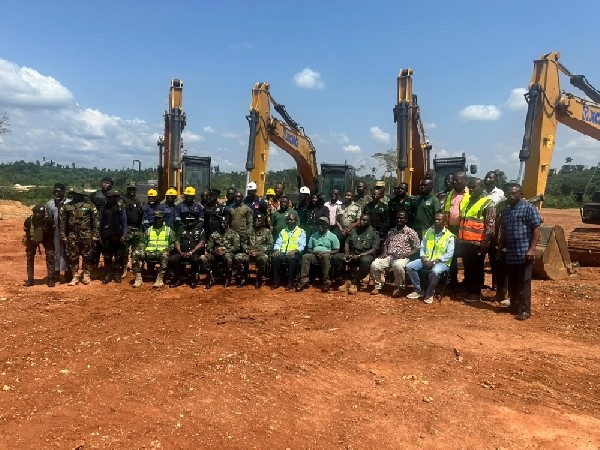
The Ghana Gold Board (GoldBod) and the Ghana Armed Forces have reclaimed 50 hectares of land in the Tano-Nimiri Forest Reserve that illegal mining had destroyed, completing the first phase of a restoration project on schedule despite relentless heavy rain. The military's 14 Engineer Brigade carried out the work and handed the rehabilitated land to GoldBod, which will transfer it to the Forestry Commission for replanting and long-term protection.
The news was first reported by GhanaWeb on November 19, 2026, and confirms that the reclamation, part of GoldBod's Corporate Social Responsibility commitments, is designed to be permanent rather than cosmetic. According to 3News, the operation marks a major step in efforts to restore forests devastated by illegal mining.
What the soldiers found in Compartment 161
Brigadier General Richard Kinney, Commander of the 14 Engineer Brigade, said his team discovered 10 large pits in Compartment 171, some as deep as 20 feet and stretching 30 to 50 metres across. Stagnant water had collected in the pits, and numerous smaller excavations scarred the surrounding area.
The work involved pumping out the water, backfilling the pits, contouring and grading the terrain to curb erosion, and reopening streams that illegal miners had blocked. Soldiers also removed soggy mud, let it dry, and blended it with dry earth and topsoil to form a firm base.
Reaching the site was its own battle. Flooding earlier this year washed away eight bridges along the access route. Brig. Gen. Kinney said the Brigade rebuilt all eight and cleared and lengthened most of the 13.6-kilometre access road so vehicles could reach the compartment again.
How GoldBod plans to keep illegal miners out
Restoring land is one thing. Defending it is another, and this project treats the second task as seriously as the first. A new Forward Operating Base, built from 10 prefabricated containers, will house 10 Forestry Commission personnel on site. It comes with a borehole, solar power, washrooms, a kitchen, a shaded resting area and chain-link fencing.
Deputy Director of Mining Operations at GoldBod, James German, speaking on behalf of Chief Executive Officer Sammy Gyamfi, revealed that a 10-year agreement with the Forestry Commission has been signed to guarantee continued restoration work and monitoring of the site.
Brig. Gen. Kinney warned that the reclamation alone will not protect the forest.
Areas previously affected by illegal mining remain vulnerable to renewed encroachment. Without sustained presence, patrols and monitoring, the resources invested could be wasted.
A new standard for responsible mining
This is where Ghana's mining story gets interesting for anyone watching the sector's direction. German said an earlier reconnaissance trip had exposed how badly the reserve had been damaged, and the board responded not with a press statement but with engineers, machines and a decade-long commitment.
He framed the project as proof that mining and environmental protection can work as partners rather than rivals.
Mining and environmental stewardship must no longer be treated as competing priorities. Responsible mining must support environmental restoration and deliver lasting benefits to the country.
German explained that effective reclamation demands careful handling of topsoil, ground stability, drainage and landscape design so that rain does not sweep the restored soil away. He said the project's success will be judged not just by the area recovered, but by how many planted trees survive, how stable the ground remains and how well the forest ecosystem rebounds.
Over time, this area must blend naturally with the surrounding forest.
Why this matters for Ghana's economic future
Ghana's gold sector remains a pillar of the national economy, and initiatives like this one show what responsible resource governance can look like in practice. As Adomonline reports, the collaboration between GoldBod and the 14 Engineer Brigade demonstrates how public institutions can combine technical capacity and regulatory muscle to reverse environmental damage at scale.
The partnership model is worth noting too. German thanked the Ministry of Defence, the Ghana Armed Forces, the Forestry Commission, regulatory agencies, Samatex, traditional authorities and neighbouring communities for their roles in the project. When security services, regulators and local leaders pull in the same direction, restoration stops being a slogan and becomes an outcome.
For the Ghanaian diaspora and investors tracking ESG standards in African mining, the Tano-Nimiri project sends a clear signal: Ghana is serious about cleaning up the sector and protecting the natural capital that agriculture, tourism and communities depend on.
Frequently asked questions
How much land was reclaimed in the Tano-Nimiri Forest Reserve?
GoldBod and the 14 Engineer Brigade of the Ghana Armed Forces reclaimed 50 hectares of land degraded by illegal mining, completing the first phase of the restoration project.
Who will manage the restored land?
GoldBod will transfer the land to the Forestry Commission for replanting and long-term protection, backed by a 10-year agreement covering continued restoration and monitoring.
What will prevent illegal miners from returning?
A Forward Operating Base built from 10 prefabricated containers will house 10 Forestry Commission personnel, equipped with a borehole, solar power and fencing to support sustained patrols and monitoring.