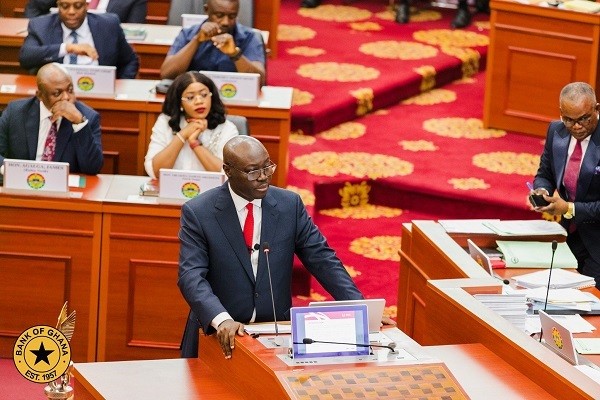
Finance Minister Dr Cassiel Ato Forson presented the 2027 Budget Statement and Economic Policy to Parliament on Thursday, November 12, 2026, unveiling a US$10 billion programme meant to build what government calls the New Economy, with jobs and prosperity at its centre.
The budget, presented under the theme “The New Economy, New Ghana, Jobs and Prosperity”, commits GH¢375 billion in total spending for 2027 and contains no new taxes, a signal that Accra intends to grow the economy by widening production rather than squeezing households again.
The headline numbers of the 2027 Budget
According to GhanaWeb, the government plans to invest US$10 billion between 2027 and 2030 under the New Economy Programme, with GH¢30 billion of that landing in 2027 alone. The programme targets job creation, higher local production and a cut in Ghana's dependence on imported goods.
The economy is projected to grow by at least 5.2% in 2027, with 5.7% growth targeted in the non-oil sector. Inflation is expected to be held at 8% by the end of the year. On the fiscal side, government expects to raise GH¢323.1 billion through taxes, other revenue and grants against the GH¢375 billion expenditure plan.
For a country still rebuilding credibility after the debt crisis, these are ambitious but coherent targets. Growth without new taxes only works if revenue collection improves, and the budget says exactly that is the plan.
No new taxes, but a harder push on collection
The government has announced it will not introduce any new taxes in 2027. Instead, it will focus on improving tax collection, preventing revenue losses and reviewing existing tax laws.
This is the part of the budget that will decide everything else. Ghana's problem has never been the absence of taxes; it has been the gap between what the law demands and what the state actually collects. A government choosing efficiency over new burdens is a government betting on its own capacity to deliver, and Ghanaians will judge that bet at the till.
Debt credibility: GH¢29 billion for bondholders
The budget makes GH¢29 billion available for the early repayment of bonds due in February 2027. The move forms part of the government's commitment to repay investors affected by the Domestic Debt Exchange Programme, the restructuring that shook confidence in Ghanaian financial markets.
For the diaspora investors and local pension funds watching from the sidelines, this is the single most reassuring line in the document. Paying back early, rather than stretching obligations, tells markets that Ghana's recovery is real and that the era of distress economics is closing.
US$3 billion for agriculture and the push to feed Ghana
Agriculture receives US$3 billion under the New Economy Programme, targeting rice, poultry, sugar, maize, fish and other products. The goal is to cut the import bill, raise local food production and create jobs in the communities that need them most.
Citi Newsroom reports that government will also uncap levies allocated to the Ghana EXIM Bank, with at least 40% of the proceeds earmarked for making Ghana self-sufficient in poultry and animal feed production. That is a direct strike at one of West Africa's most painful import lines: frozen chicken.
Ghana to stop exporting raw manganese and bauxite by 2030
The boldest structural move in the budget concerns minerals. The government plans to refine 70% of gold produced by small-scale miners locally by December 2027, rising to 100% by December 2028. Raw manganese and bauxite exports will end by 2030.
This is value addition finally moving from conference speeches to policy deadlines. Accra Street Journal notes the budget's framing that minerals and cocoa must gain value in Ghana before export, alongside affordable finance for farmers and manufacturers and reliable energy for a 24-hour economy. If implemented, the ban on raw ore exports could shift billions in processing value from foreign smelters to Ghanaian plants and Ghanaian workers.
GH¢48 billion for education
Education receives GH¢48 billion, including GH¢11.2 billion for the Ghana Education Trust Fund and GH¢1.37 billion to end the double-track system that has split secondary school schedules since 2018.
The allocation also includes GH¢537 million for the No Fees Stress policy and GH¢292 million for the Free Sanitary Pads Programme for schoolgirls. Ending double-track alone will be watched closely by parents across the country; it removes one of the most disruptive legacies of the free senior high school expansion.
Healthcare and infrastructure: the Big Push
The Ministry of Health will receive GH¢40.3 billion, including GH¢10.2 billion for the National Health Insurance Scheme, GH¢2.6 billion for MahamaCares and GH¢1 billion to complete 35 Agenda 111 hospitals.
Infrastructure gets its own vehicle: GH¢29.8 billion for the Big Push Programme to construct and improve roads and major infrastructure nationwide, with the Ministry of Roads and Highways receiving a further GH¢11.3 billion for construction and maintenance. Modern Ghana carries the full budget text, which also commits US$500 million between 2027 and 2030 to modernise the transmission system and end dependence on costly emergency power by 2030.
What happens next
The 2027 Budget is a plan built for an Africa that is moving: production at home, value added before export, and public money pointed at schools, hospitals and roads rather than debt service alone. The Custodian describes the strategy as investment-led, export capable and job-intensive.
The test now shifts from Parliament to implementation. The figures are on the table; the deadlines are set; and by February 2027, the first bond repayments will show whether the New Economy is a slogan or a system.
FAQ
What is the theme of Ghana's 2027 Budget?
The theme is “The New Economy, New Ghana, Jobs and Prosperity”, presented to Parliament by Finance Minister Dr Cassiel Ato Forson on November 12, 2026.
Are there new taxes in Ghana's 2027 Budget?
No. The government will not introduce new taxes in 2027 and will instead improve collection, prevent revenue losses and review existing tax laws.
How much is Ghana investing in the New Economy Programme?
The government plans to invest US$10 billion between 2027 and 2030, with GH¢30 billion planned for 2027 alone.
When will Ghana stop exporting raw manganese and bauxite?
By 2030, as part of efforts to process minerals locally and retain more value in the country.