
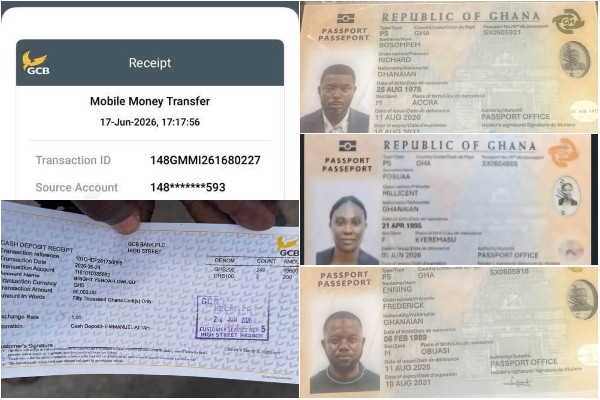
Former presidential staffer Charles Nii Teiko Tagoe has released documents that appear to expose the inner workings of an alleged passport-selling syndicate at Ghana's Ministry of Foreign Affairs, days after the Ministry cancelled 10 illegally issued Service Passports on November 8, 2026.
The files, shared on social media, include biodata pages of five Service Passports, approval letters signed on behalf of the Foreign Minister, and screenshots of mobile money transfers and bank receipts that appear to show payments tied to the scheme. According to GhanaWeb, the passport pages carry the names of Wallee Ibrahim, Asante Rebecca Arthur, Enning Frederick, Fosuaa Millicent and Richard Bosompem.
What the documents show
The approval letters were signed by Ambassador Khadija Iddrisu, the Ministry's Chief Director, acting for the Minister for Foreign Affairs. They authorise the issuance of Service Passports to individuals under specific categories.
The mobile money screenshots and bank receipts suggest a payment trail running alongside the approvals. One petitioner told the Ministry they paid US$29,000 in 2023, while another reported paying US$5,000 in 2026 to people inside the alleged cartel. The authenticity of the documents has not been independently verified, and the circumstances of the transactions remain under investigation.
Ministry moves fast: 10 passports cancelled, two officials interdicted
The Ministry of Foreign Affairs announced on November 8, 2026 that preliminary investigations confirmed 10 people obtained Service Passports through illegal payments to a syndicate operating inside the passport system. The passports, issued between January 2023 and August 2026, have been cancelled and Ghana's international partners have been notified that the documents are no longer valid.
The affected individuals are Richard Sakyi Apenteng, Augustina Agyei Boateng, Juliet Amankwa, Rebecca Agyeiwaa, Prince Ahensah, Maybel Ahensah, Twumasi Francis Kwame, Gyabaah Anthony, Frederick Ennin and Bosompem Richard.
The Ministry also interdicted the Acting Director of Passports, Mahama Yahaya Amantana, and a junior Foreign Service Officer, Alhassan Sumani, both named in petitions about the scheme. The two have been referred to the Ghana Police Service for further investigation and possible prosecution. Pulse Ghana reported the cancellations and interdictions as part of the Ministry's widening response.
Parliament's Minority adds bank records
The scandal has now reached Parliament. Nkonkonsa reports that the Minority in Parliament says it has obtained bank deposit receipts and mobile money transaction records allegedly showing payments to an agent connected to the sale of Ghanaian diplomatic and Service Passports.
That means the evidence is no longer confined to social media posts and ministry petitions. Lawmakers are now holding financial records they say trace the money, which raises the pressure on the government to act in the open and to act quickly.
Why the Service Passport is worth so much money
A Service Passport is an official travel document issued to public officials and others who qualify under Ghana's laws. It signals that the holder travels in an official capacity, though it does not confer diplomatic status or immunity.
Its real value lies in mobility. According to the Ministry of Foreign Affairs' official visa-free travel portal, Ghanaian Service Passport holders can enter 59 countries under visa-waiver arrangements, against 41 for ordinary passport holders. Entry conditions and permitted lengths of stay vary by destination, and holding the document does not guarantee entry everywhere.
That gap, 59 countries versus 41, explains why someone would reportedly pay US$29,000 for one. It also explains why the scheme grew inside the very office charged with protecting the integrity of Ghana's travel documents.
Transparency is the only fix
For a country positioning itself as a serious destination for investment, trade and diaspora engagement, a passport scandal is costly well beyond the ten cancelled booklets. Every fraudulent document chips away at the trust that foreign governments, airlines and border agencies place in Ghanaian credentials.
The Ministry's decision to cancel the passports, notify international partners and refer the officials to the police is the right first step. The next test is prosecution and recovery of the proceeds. Ghanaians, including the diaspora communities whose remittances and business ties anchor the economy, deserve a system where the rules decide who gets a Service Passport, not cash transfers to a syndicate.
Frequently asked questions
What is a Service Passport in Ghana?
It is an official travel document issued by the Ghanaian government to eligible public officials and other qualified persons for travel connected to official government duties. It does not confer diplomatic status or immunity.
How many countries can a Ghanaian Service Passport holder visit without a visa?
According to the Ministry of Foreign Affairs, Service Passport holders have access to 59 countries under visa-waiver arrangements, compared with 41 for ordinary passport holders.
What has the Ministry done about the passport scandal?
It cancelled 10 Service Passports issued between January 2023 and August 2026, interdicted the Acting Director of Passports and a junior Foreign Service Officer, and referred both to the Ghana Police Service for investigation and possible prosecution.