
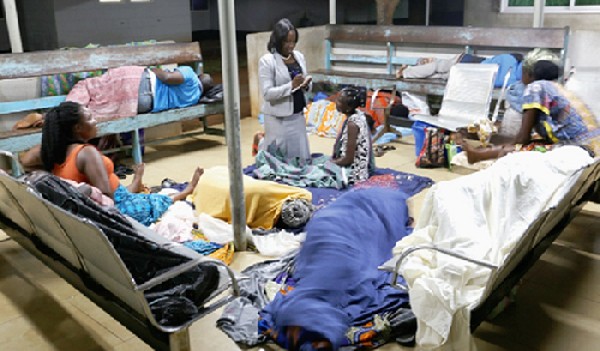
Ghana is taking its most serious swing yet at the notorious No Bed Syndrome, with President John Dramani Mahama directing major hospitals to expand emergency bed capacity to at least 10 per cent of their functional bed capacity, a move that could more than double emergency spaces at facilities like Korle Bu Teaching Hospital.
The directive, announced in November 2026, targets the country's leading teaching and referral hospitals and forms part of a broader government response to a crisis that has seen emergency patients turned away, referred elsewhere, and in some documented cases treated on floors, benches and chairs. TechFocus24 reported that the initiative requires major hospitals to reserve at least 10 per cent of their functional beds for emergencies, a figure that would transform intake capacity at institutions that currently dedicate a fraction of their space to urgent care.
What the No Bed Syndrome really means
The phrase sounds simple, but the problem runs deeper than a shortage of mattresses. According to GhanaWeb, the syndrome describes situations where patients seeking emergency treatment are turned away or referred elsewhere because hospitals claim they lack available beds or the capacity to provide the required care.
In reality, the crisis reflects a chain of constraints: inadequate infrastructure, shortages of emergency medicines, missing diagnostic equipment, insufficient transport, limited hospital supplies and not enough trained personnel. A 2023 peer-reviewed review of the phenomenon in Ghana documented cases where patients received emergency attention on floors and benches because of overcrowding. When a hospital says it has no bed, it often means it has no nurse to monitor that bed, no oxygen to supply it, or no working equipment beside it.
President Mahama made this point directly. GBC Ghana reported that the President stressed effective emergency care requires trained medical personnel, functional equipment, oxygen and essential medical supplies, not just physical beds. That framing matters, because it signals the government understands that fixing the numbers without fixing the system would be cosmetic.
The numbers behind the crisis
The scale of the challenge is stark. In March 2026, the Ghana Registered Nurses and Midwives Association reported that Ghana had approximately 0.7 hospital beds per 1,000 people. The association also cited an estimated national bed count of 19,907 recorded in 2015, and warned that some major hospitals were operating at occupancy levels between 120 and 150 per cent.
Occupancy above 100 per cent means patients are being placed wherever space allows, corridors included. For a country of over 30 million people with ambitions to become West Africa's healthcare hub, those figures are a brake on growth. Medical tourism flows to India and Turkey partly because Ghanaians with means do not trust the emergency system at home. Fixing emergency care is not only a moral imperative; it is an economic one.
Korle Bu shows what the target would change
Korle Bu Teaching Hospital in Accra offers the clearest illustration. According to information released by the Information Services Department following the President's announcement, Korle Bu has a functional bed capacity of 1,500 but only 65 beds in its Accident and Emergency Department.
The government's target of at least 150 emergency beds would more than double the department's current capacity. That gap between total capacity and emergency capacity is exactly what the new policy is designed to close. Citi Newsroom reported that the President directed the expansion at four major hospitals, signalling that the reforms start where the pressure is highest.
Digital bed management enters the picture
The government is pairing physical expansion with technology. In October 2026, the Ministry of Health disclosed that more than 650 hospitals had been captured in a digital bed management system, with over 5,000 beds mapped for monitoring and regular updates.
The pilot involves selected teaching hospitals, the Greater Accra Regional Hospital, the University of Ghana Medical Centre and the National Ambulance Service. The system is designed to provide real-time information on bed availability, ambulance movements and each hospital's capacity to receive patients.
This is the kind of innovation Ghanaian entrepreneurs and health tech firms should watch closely. A functioning national bed registry could cut referral delays, reduce ambulance turnaround times and give emergency dispatchers the data they need to route patients to the right facility the first time. The catch, as the Ministry itself would concede, is execution: the system only works if hospitals update their information regularly and if the beds flagged as available come with the staff, equipment and specialist services to actually treat incoming patients.
Doctors push for an Emergency Care Act
The Ghana Medical Association has gone further than bed numbers. At its 68th annual conference, association president Professor Ernest Yorke called for an Emergency Care Act to establish minimum standards for emergency treatment, strengthen referral arrangements and provide a clearer framework for financing emergency services.
Professor Yorke argued that patients and their families should not be left moving from one hospital to another in search of emergency treatment. That is a call for accountability, and it deserves a legislative answer. An Emergency Care Act would define who is responsible when a patient is turned away, how referrals must be handled and how emergency services are funded. These are the transparency measures that turn announcements into durable reform.
Why this matters for Ghana's economy and the diaspora
For the Ghanaian diaspora, healthcare reliability is a constant calculation when deciding whether to return, invest or retire at home. Every story of a patient turned away erodes confidence. Every hospital that answers emergencies well builds it.
The private sector also has a role. The bed management system, the expansion of emergency departments and the push for minimum standards will create demand for health technology, medical equipment, logistics and facility management services. Ghanaian firms that position themselves early in this value chain will benefit as the reforms roll out.
The road ahead depends on delivery. Hospitals must hit the 10 per cent emergency bed target, update the digital system faithfully, and staff the new beds with trained personnel. If the government holds its own directives to account, Ghana could finally retire a phrase that has haunted its health sector for too long.
Frequently asked questions
What is the No Bed Syndrome in Ghana?
It is the situation where patients seeking emergency treatment are turned away or referred elsewhere because hospitals say they have no available beds or lack the capacity to provide the required care, often due to shortages of staff, equipment and supplies rather than beds alone.
What did President Mahama announce in November 2026?
He directed major teaching and referral hospitals to expand emergency bed capacity to at least 10 per cent of their functional bed capacity, alongside a digital bed management system covering more than 650 hospitals and over 5,000 mapped beds.
How many emergency beds does Korle Bu have?
Korle Bu Teaching Hospital has a functional bed capacity of 1,500 but only 65 beds in its Accident and Emergency Department, according to the Information Services Department. The new target implies at least 150 emergency beds.
What is the Ghana Medical Association proposing?
The association, led by Professor Ernest Yorke, is calling for an Emergency Care Act to set minimum standards for emergency treatment, strengthen referrals and clarify how emergency services are financed.